Work History: Microsoft Turn 10 Studios - Software Engineer II
What I did as a Software Engineer II at Microsoft Turn 10 Studios from 2017-10 to 2019-04.Table of Contents:
I was promoted early in the development of Forza Motorsport 7 after demonstrating impact as a Software Engineer I. I delivered a wide range of high-impact work on the project. I'm still proud of that work today.
Highlights include being the top defect-resolver by volume in the critical run-up to launch, stabilizing and turning around a contractor team responsible for post-launch features, and implementing product-security measures that successfully prevented piracy for over a year after release.
Below is a detailed breakdown of my contributions to Forza Motorsport 7.
Most of my work on Forza Motorsport 7 focused on building and supporting the game's economy. I implemented many of the cross-game systems that powered progression, rewards, and player engagement, including:
- 3D Car Select (discussed in earlier work history).
- A cross-game card experience used to represent collectible items.
- A tiered car-collection system designed to make ownership and progression compelling.
- The post-race reward flow, allocating payouts based on race performance.
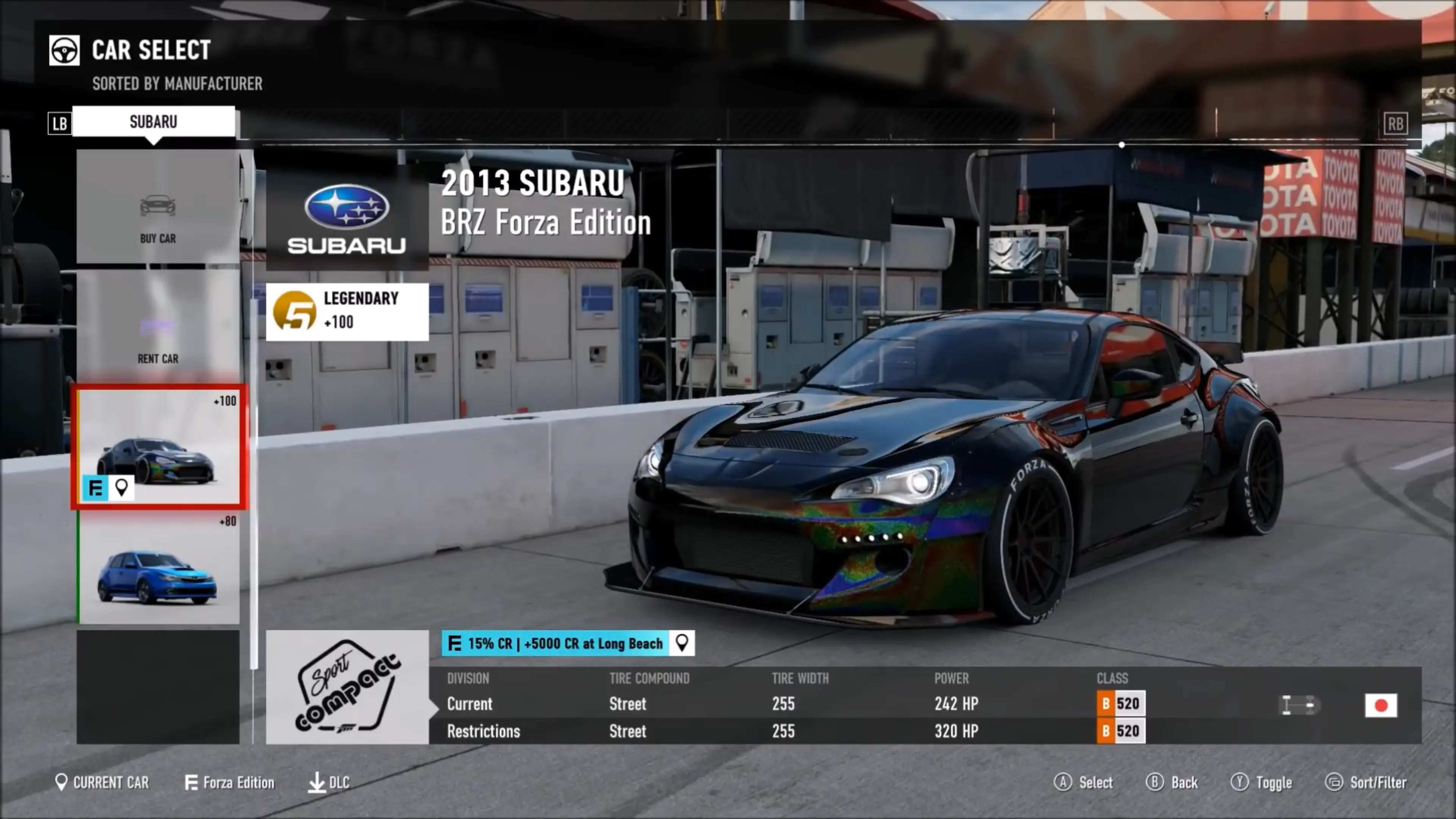
- Special "Forza Edition" cars with unique attributes.
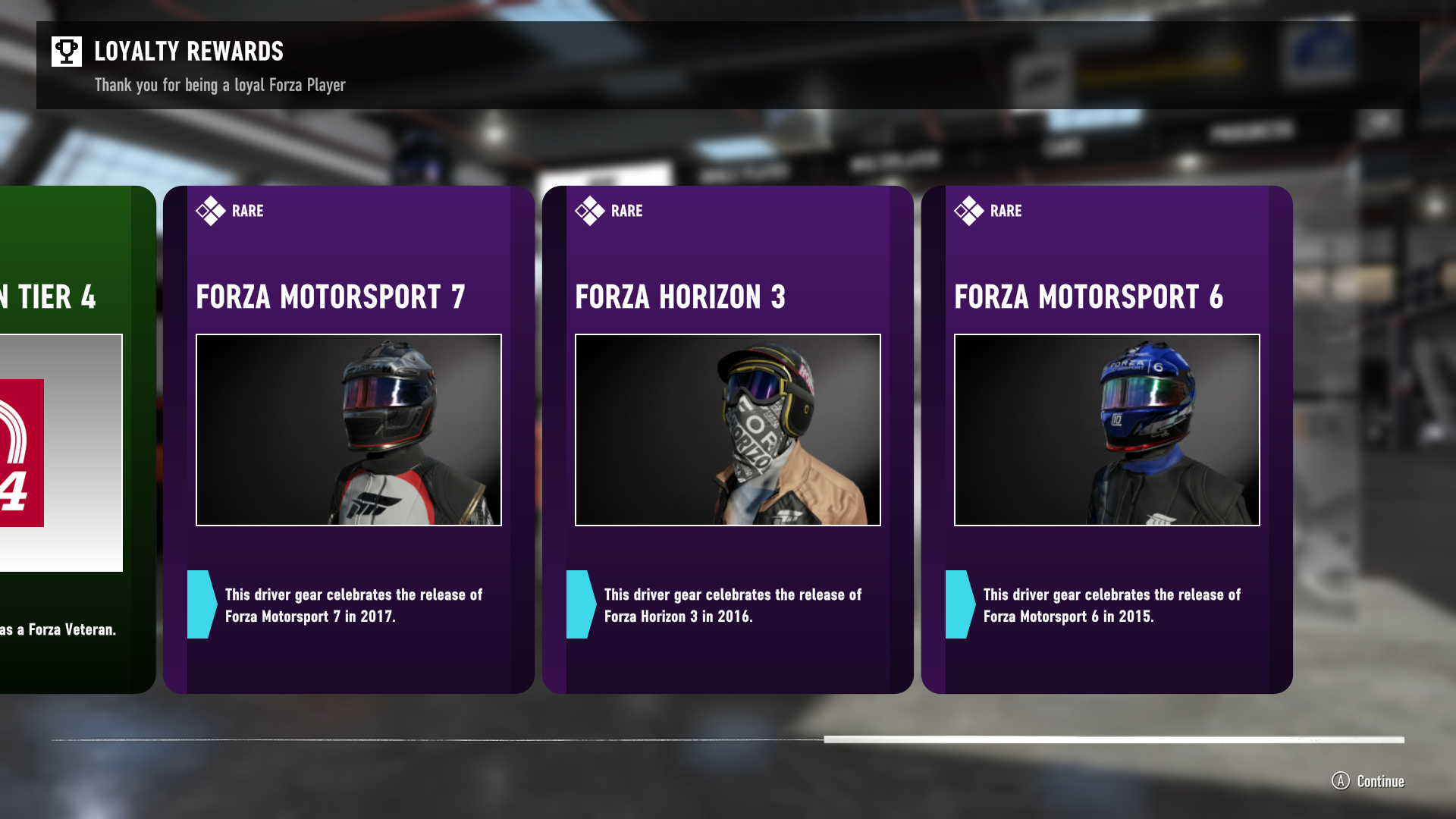
- Loyalty rewards to incentivize returning players from previous titles.
Forza used a SQLite database to store car and track data, making it easy to author information for over 700 cars. A second SQLite database was mounted at runtime to track car ownership, enabling efficient querying of a player's garage. Career data, settings, and other player state were stored using a binary serialization format with an XML-like API. All writable data across these systems was cloud-synced to support seamless play across devices.
Together, the SQLite databases and binary storage formed the foundation of the economy, giving teams a powerful, familiar platform to build and integrate features.
Forza Motorsport 7 represented ownable content through card-based UI designed by Nic Johnson. We initially explored outsourcing the implementation, but contractors couldn't meet our visual bar on the required timeline. Key details like rounded corners would have been cut to simplify delivery. Because these cards directly shaped the player's experience of the economy, I wasn't willing to compromise. I volunteered to build them myself over the weekend and delivered a polished, integration-ready solution by Monday including animations and a developer-only page for debugging.
As players collected cars in Forza Motorsport 7, they earned Collector Score and advanced through Car Collection Tiers. Higher tiers unlock improved rewards throughout the game and expanded the cars available for purchase. I put the game-wide tier system in place, and implemented the progress animation shown as the player's score increases.
After every race in Forza Motorsport 7, players earned Driver Level experience. Upon leveling up, they selected one of three rewards. Players could also apply Mod Cards before a race to boost the experience they earned based on their performance.
I ported the Driver Level and Mod Card Systems from previous titles intoForza Motorsport 7 and implemented the post-race progression screen.
Forza Edition cars are special vehicles with unique perks that make them more desirable than their standard counterparts. Building on the success of Horizon Edition cars in previous Forza Horizon titles, we brought this concept to the Motorsport series. I ported the underlying logic and integrated Forza Edition cars across the entire game.
Loyalty Rewards granted perks to players returning to Forza Motorsport 7 after playing previous titles. The feature appeared once near the end of the Initial Experience. I implemented the system that detects prior save data and awards the appropriate rewards.
One of the most impactful features I worked on for Forza Motorsport 7 was leading the client-side security effort. We built our protections on a framework from Arxan, which allowed us to define protected regions of code via XML. During the build process, these regions were obfuscated and then deobfuscated at runtime through runtime code modification. This approach made reverse-engineering difficult, as any dumped memory contained only temporarily valid code.
Client security was new territory for me, so much of the work involved learning quickly and leaning on the expertise of others. I benefited from the deep security knowledge within Microsoft, often standing on the shoulders of giants. Near the end of development, NCC Group, a world-class security organization, conducted a formal review of our implementation. I worked through their findings and incorporated recommended improvements.
Integrating these security features into our build pipeline was an intensive, iterative process. I would tweak a setting, run a build, review logs, adjust, and repeat. Putting the finishing touches in place ultimately required an all-nighter, making small changes and validating each one through full builds.
That effort paid off. Forza Motorsport 7 went eight months without piracy, an unheard-of result. Keeping a game piracy-free through the launch window is critical to maximizing sales, and while I had hoped we might last a month, eight months exceeded all expectations. After launch, I continued to own the effort by keeping the management team informed through a weekly security newsletter. This remains one of my proudest achievements on the project.

Following the launch of Forza Motorsport 7, we formed a cross-disciplinary strike force to reduce crash rates and address our highest-impact defects. Each team--engine, gameplay, multiplayer, UI, and others--contributed a representative to ensure issues could be investigated and resolved end-to-end. I served as the UI team's original representative on this strike force.
In this role, I improved how the UI team approached defect resolution as a whole. Previously, developers were expected to fix bugs after completing feature work. In practice, it was difficult to know when a feature was "done enough" to switch focus, and feature development often ran late. As a result, defects were frequently deferred or rushed. Compounding the problem, some bugs required only a day or two to resolve, while others demanded a full week.
To address this, I helped move the team to a Bug Weeks model:
- Each week, one developer was assigned exclusively to fixing bugs.
- That developer also served as the Quality Strike Force representative.
- Their focus was on the highest-impact UI issues across all features.
The results were strong. Developers on Bug Weeks had the time and context needed to resolve serious issues properly. Cross-feature understanding improved as engineers worked outside their usual areas, and knowledge from the strike force was continuously fed back into the team. This distributed quality ownership across the group instead of concentrating it on a single person. As a result, we systematically eliminated our top UI issues and significantly improved overall stability.
I've since seen this Bug Weeks succeed across multiple teams and studios, and have continued to apply it throughout my career.
As Forza Motorsport 7 transitioned from launch into Live Ops, two senior managers went on paternity leave and vacation, creating a temporary leadership gap. At the same time, Turn 10 brought on Sumo Digital to help ship the game and support it post-launch. Because I had already been working closely with Sumo on economy features in the lead-up to launch, I was asked to step in as the lead for that partnership.
This was my first leadership role at a large studio. Together, we delivered the majority of Forza Motorsport 7's Live Ops content. While the engagement struggled before I was involved, performance improved steadily during my tenure, and by the time I transitioned out of the role, our Director, Daniel Adent, commended me for "turning the team around." I was proud to leave the partnership in a stronger place than when I stepped in.
Together, we shipped the following Live Ops features:
- 1. Forzathon: a recurring weekly challenge and progression system
- 2. Forza Race Regulations: an advanced rules engine for multiplayer and esports events
- 3. Spectating: a UI for observing and commentating on races, supporting our esports broadcasts
- 4. Leagues: a competitive multiplayer mode built around monthly challenges
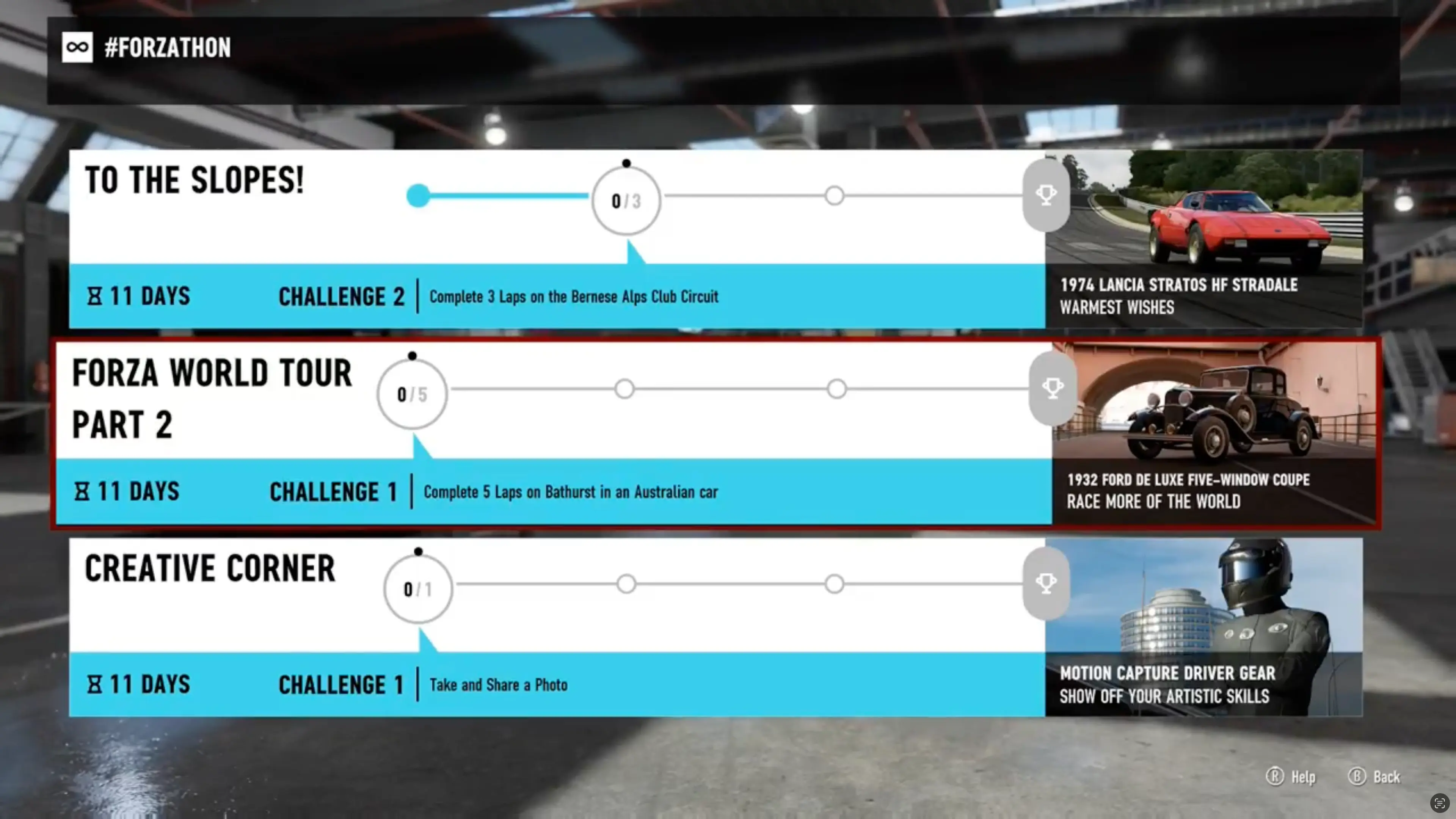
Forzathon was a weekly live-ops challenge system. Each week, the Live Ops team authored multiple challenge lines, each consisting of a short series of objectives that culminated in a reward. Players progressed through these objectives to earn the associated rewards, with new challenge sets rotating in.
The original implementation of Forzathon was built on the same infrastructure as Xbox Achievements, which introduced several issues. Progress updates could be slow to propagate globally, meaning objectives might take hours or even days to unlock locally after completion. The system was also difficult to configure, which created friction for the Live Ops team. We often staffed content creation with developers new to the industry, configuration complexity directly impacted their productivity and iteration speed.
Forzathon was going live as Sumo Digital's management transitioned under my leadership. After reviewing the system, I raised concerns with management that while we could ship, we would do so with significant user-facing issues. In partnership with Product Management, I proposed replacing the Achievement-based backend with the internal objective-tracking system used in the Forza Horizon series. I imported that technology and worked with Sumo to plan and execute a rewrite of this layer of the stack.
The project ran ahead of schedule, and within a couple of months we resolved the core issues with Forzathon. We also replaced the existing configuration workflow with a single XML-based system, supported by a formal schema and several dozen pages of documentation. This dramatically simplified content creation: the Live Ops team could copy, paste, and modify weekly challenges instead of working through a clunky browser-based UI. Our Live Ops director later told my manager that, "no one has ever given us anything this detailed," and the new system improved the team's speed and confidence in shipping weekly content.
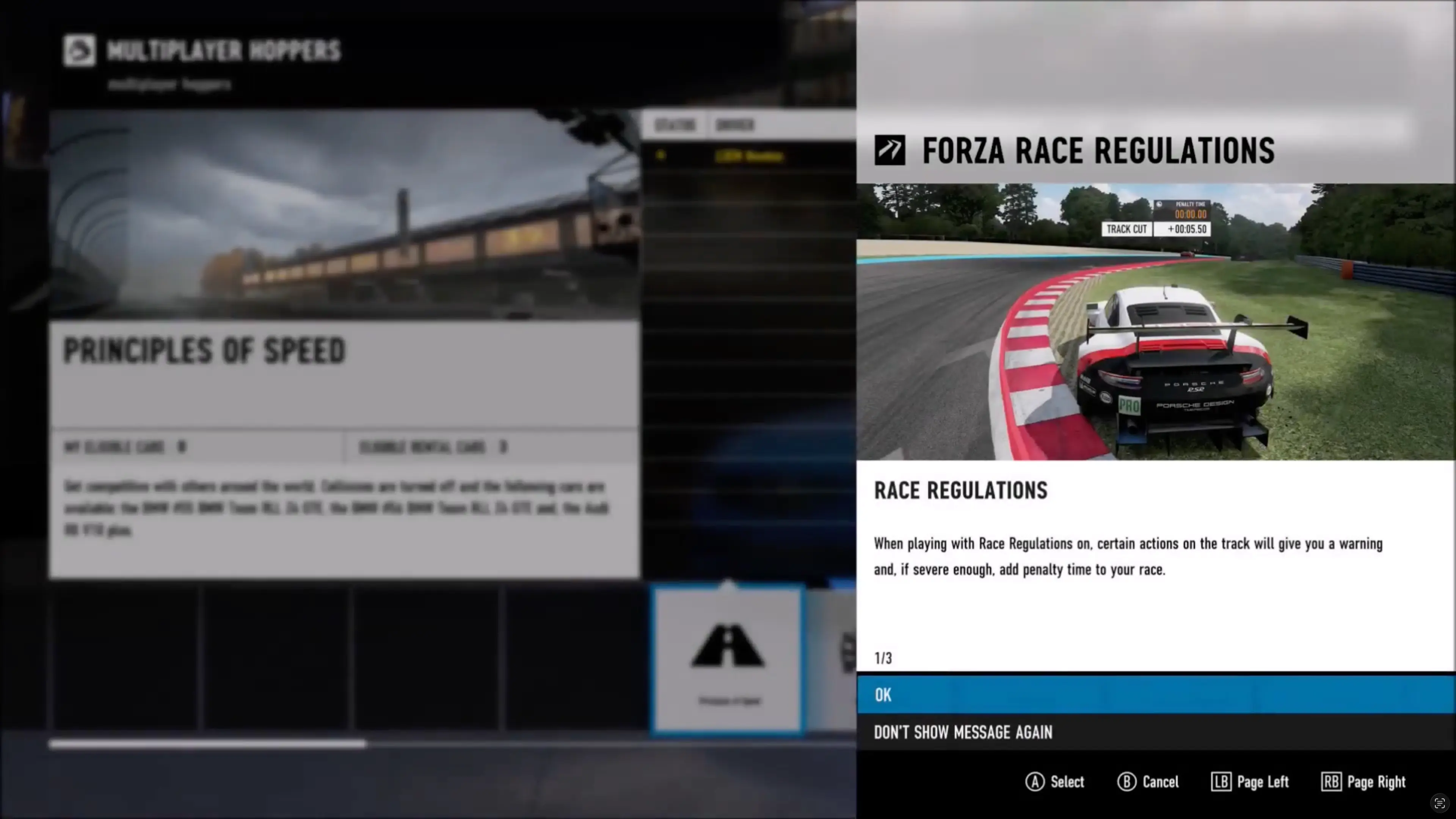
Since its first multiplayer title, Forza grappled with a fundamental tension between players who prioritize simulation and those who prioritize fun. Simulation-focused players treat online races like real driving: carefully navigating corners, avoiding contact with other racers, and generally respecting the rules of the road. Fun-focused players push the limits by slamming into turns, riding the wall to adjust yaw, and accelerating at full throttle whenever possible.
Race regulations were our solution for creating a better space for simulation-focused players. They allowed players to enable penalties that discouraged non-simulation behaviors, such as deducting time or disqualifying racers who used walls or other cars to assist with turning. This system helped balance the tension between the two play styles since players could opt-in to their preference up front.
Race Regulations benefited from the momentum established during Forzathon. With the foundation and working relationships already in place, the project ran smoothly from start to finish and shipped without major issues, demonstrating a transition from system recovery work to consistent, reliable delivery.
Spectating was designed to support Forza Motorsport 7's esports initiative with a competitive viewing presentation tailored for broadcast. It allowed broadcasters to track drivers while clearly displaying player information such as names, positions, lap times, and gaps to competitors. The presentation combined dynamic camera angles with clean HUD overlays, making race progression and on-track battles easy to follow. Together, these elements created an experience that felt like a professional motorsport broadcast.
Spectating marked the point where complex, high-visibility features could be executed with confidence. Building on prior successes, the system shipped cleanly and supported Forza Motorsport 7's esports broadcasts without disruption, reflecting a contractor who had progressed into a dependable owner of critical systems.
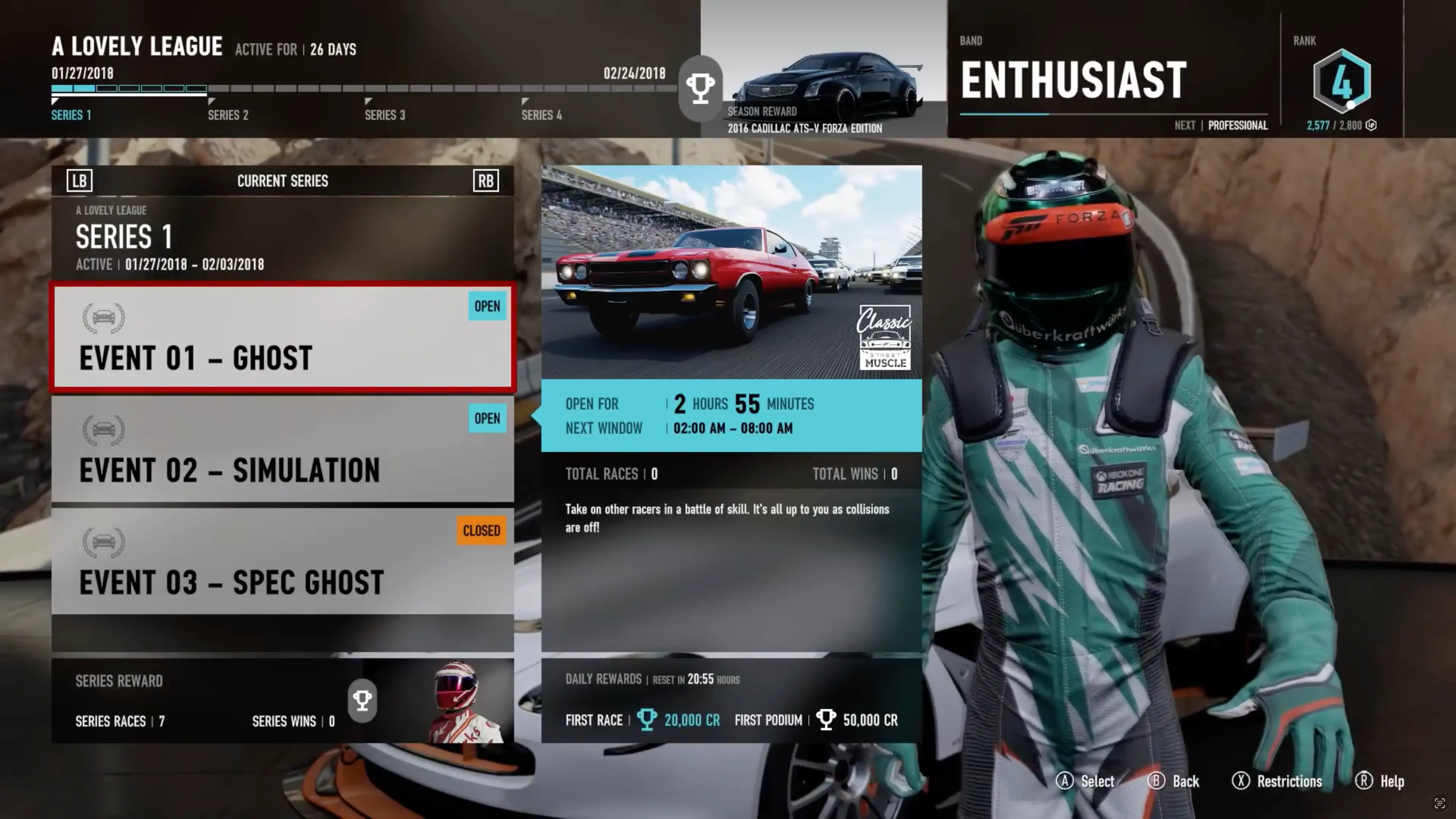
Leagues were a ranked online multiplayer mode that grouped players by skill into tiers and ran on weekly competitive cycles. Drivers competed in regulated events with fixed car classes and rules, earning skill ratings based on race results and clean driving. Performance determined promotion, creating a structured, high-stakes alternative to casual multiplayer.
This feature built on our existing Race Regulations and Spectating systems, further advancing our competitive multiplayer and esports capabilities. By the time the project concluded, Sumo Digital had established a track record of success under my leadership. The studio was ready for a transition, and I was asked to begin pre-production on our next title. Daniel Adent, the engineering director of Turn 10 left me with the message, "you really turned that team around."
Forza Motorsport was the next entry in the series following Forza Motorsport 7. I spent a few months in preproduction before deciding to pursue starting my own company. Despite the short tenure, I contributed durable technology that continued to benefit the team's development efforts after I left.
The last project I worked on at Turn 10 was UI authoring tools for our next title, the Forza Design Surface. The Design Surface was software that synchronized changes made in our UI design tools—Blend or Visual Studio—with a running Forza client, allowing designers to see UI updates in-game immediately.
With the Design Surface, staff could see and edit UI immediately on game startup, avoiding an expensive load past the title screen. Prior to the Design Surface, the UI workflow relied on a WYSIWYG editor that only loosely matched the final in-game presentation. Staff would build in WYSIWYG and then load the game all the way into the target screen. If a race needed to be completed first, a single iteration could take over ten minutes.
Key technologies behind the Forza Design Surface included:
- A custom XAML parser that enabled our proprietary editor UI to render inside Blend and Visual Studio
- A sample-data system that generated UI binding data from reusable XML definitions
- A live synchronization pipeline that propagated UI changes from the editor directly to the running game client
- An in-game Design Surface screen that loaded before the title screen and hosted the runtime integration with the editor tools
I built most of this technology single-handedly in a matter of weeks, which was especially gratifying after spending a year in a management role. I was worried I lost my mojo and it was great to discover that I was as sharp as ever. During a presentation with the Blend team, I walked through the implementation and explained that, due to sparse documentation, much of my reference material came from archived sources. The Blend PM was surprised to learn that this meant relying on documentation that was no longer publicly available. The reaction from the room made it clear that the scope and speed of the work were beyond what anyone believed was possible.